Emergency Plumbing
A heater leaking onto the floor is an emergency, not an appointment. Shut off its supply and call us now.
Emergency plumber in SchaumburgCold showers, a rumbling tank, rusty hot water, or a puddle spreading under the heater — water heater problems announce themselves clearly once you know the language. We service tank and tankless units across Schaumburg, repair what genuinely needs repairing, and give you an honest verdict when replacement is the smarter money.
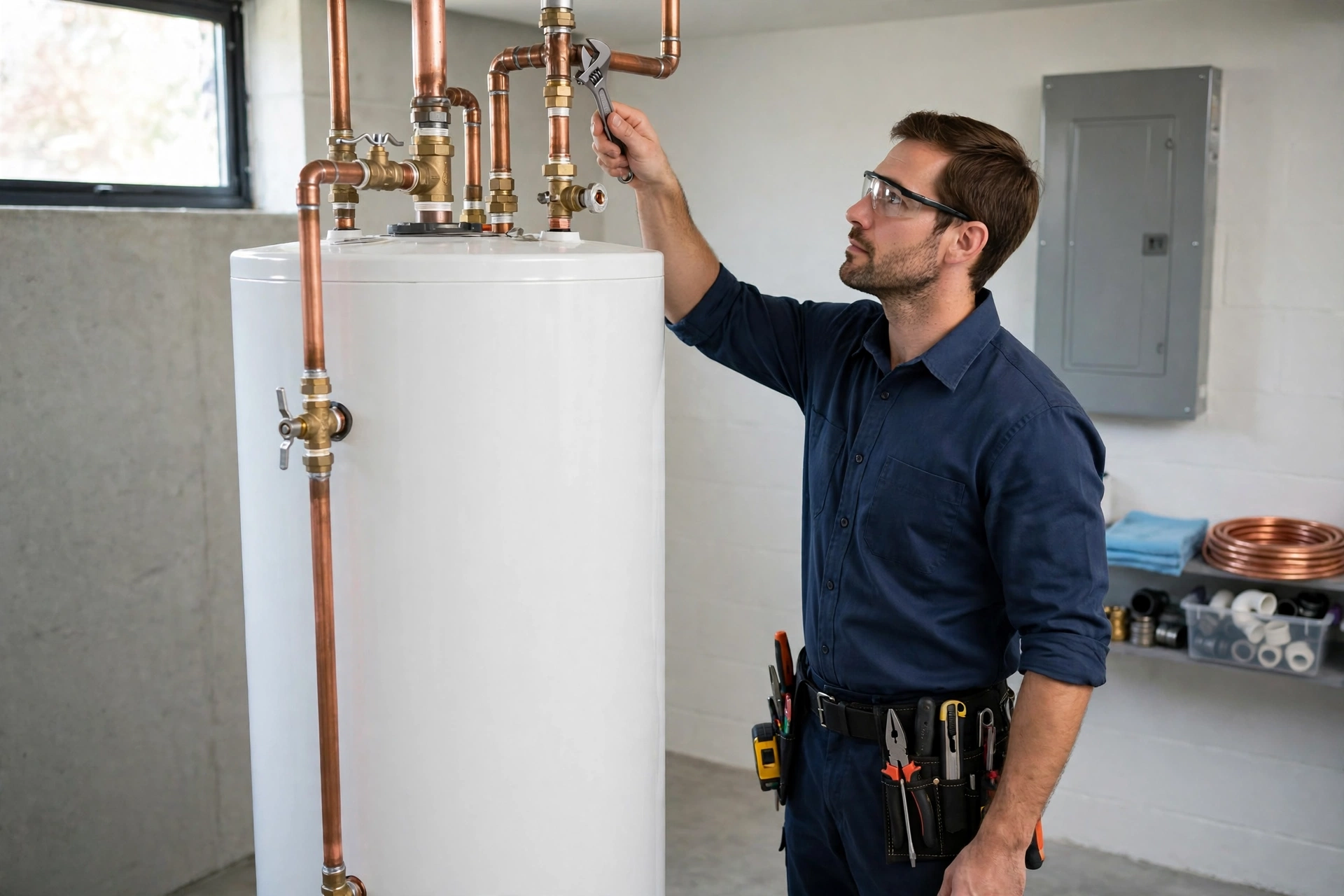
A water heater is a simple machine with a handful of failure modes — which means most problems trace back to a short list of parts: a failed heating element or burner, a thermostat that no longer reads temperature accurately, a pilot or igniter that won't stay lit, a pressure relief valve doing its job because something else isn't, or sediment that has been quietly insulating the tank's heat source from the water. Our job on a repair call is to identify which one you're dealing with, show you the evidence, and price the fix — before anyone starts replacing parts on speculation.
Schaumburg's water shapes these failures. The village's municipal water is moderately hard, and every gallon heated in your tank leaves a little of that mineral content behind. Over the years it builds a sediment layer on the tank floor that insulates the burner, wastes energy, overheats the tank bottom, and produces the classic popping and rumbling sounds homeowners describe as "the heater sounds angry." An electric unit buries its lower element in that sediment until the element burns out. Meanwhile the anode rod — the sacrificial rod inside the tank that corrodes so the tank doesn't — depletes silently. Once it's gone, the tank itself starts rusting, and that failure has no repair.
That last point drives our repair-or-replace honesty. A five-year-old heater with a dead element is a repair, full stop. A twelve-year-old tank that's leaking from the tank body is a replacement, and any company offering to "repair" a rusted-through tank is selling you a delay, not a fix. When we recommend replacement, we'll show you the age plate, the rust, and the reasoning — and when we recommend repair, it's because the numbers genuinely favor it.
Water heaters rarely die without warning. These are the warnings — roughly in the order homeowners notice them.
Showers that run cold fast, or a tank that can't keep up with a normal morning, usually mean a failed element, a burner problem, or sediment stealing the tank's effective capacity.
That's sediment on the tank floor, trapping water that flashes to steam. It's the sound of wasted energy and a tank aging faster than it should — a flush and inspection are overdue.
Brown or tea-colored water from hot taps only points inside the heater: a depleted anode rod and a tank beginning to corrode. Caught early, a rod replacement buys years.
A damp ring or puddle under the heater can be a fitting, the drain valve, or the relief valve — or the tank itself. The source decides whether this is a small repair or an urgent replacement.
Gas units that keep dropping the pilot usually have a failing thermocouple or a venting issue; tankless units report their problems as error codes. Both are diagnosable — and repairable — faults.
Tank heaters typically serve 8–12 years, less under heavy sediment load. An aging unit with new symptoms deserves a condition check before you spend on parts.
We secure the unit first — power, gas, water — then test what's failing: elements, thermostat, burner, ignition, valves, and the tank's overall condition and age.
You see what we found and hear the honest math: the repair cost against the unit's age and remaining life. No pressure either direction — the numbers decide.
Approved repairs are completed, sediment is flushed, and the anode rod is inspected — because fixing the symptom while ignoring the cause is how heaters die young.
We verify recovery time, set temperature safely, test the pressure relief valve, and check for leaks under pressure before we call it done.
Two local facts dominate water heater work in Schaumburg. The first is mineral content: heated water drops sediment, sediment insulates and overheats, and tanks here live harder lives than the same models in soft-water regions. An annual flush and a mid-life anode rod replacement are not upsells in this water — they're the difference between a heater that serves twelve years and one that gives up at seven. If your heater has never been flushed, the rumbling you hear on a quiet morning is the sediment introducing itself.
The second is January. Incoming water arrives at its coldest in a Schaumburg winter, which means your heater works hardest — and your hot water runs out fastest — exactly when a cold shower is least welcome. A unit that "was fine in July" but can't fill a tub in January is often undersized for winter recovery or losing capacity to sediment. We factor both realities into the repair-or-replace conversation: the right answer for your home considers your water, your winter, and your household's actual demand — not just the part that failed.
We repair and replace water heaters across Schaumburg, Hoffman Estates, Palatine, Elk Grove Village, Roselle, and Rolling Meadows. If your hot water is out or going, call (224) 524-0786 — tell us the symptoms and the unit's age if you know it, and we'll come prepared.
The repair-or-replace questions Schaumburg homeowners ask most.
Age and the type of failure decide it. A unit under about eight years old with a failed element, thermostat, igniter, or valve is almost always a repair. A tank that's leaking from the tank body itself can't be repaired — the steel has corroded through. Between those poles, we show you the repair price against the unit's age and condition and let the math speak. What you'll never get from us is a replacement recommendation for a heater with real life left in it.
Sediment. Schaumburg's water leaves mineral deposits that build up on the tank floor; water trapped under that layer overheats and flashes to steam, and the popping and rumbling is the sound it makes escaping. Beyond the noise, sediment insulates the burner, raises energy use, and overheats the tank bottom — shortening its life. A flush removes much of it; on an inspection we can also check the anode rod, which protects the tank itself from corrosion.
Yes. Tankless units fail differently — ignition faults, flame failures, and above all scale buildup in the heat exchanger, which in hard water needs periodic descaling to keep efficiency and avoid error-code shutdowns. Many tankless "failures" are maintenance debt rather than broken parts. We diagnose from the unit's error codes and service both the fault and the cause.
Urgent enough to act today. First, find the source if you safely can: a fitting or the drain valve is a small repair, but water seeping from the tank body means the tank is failing and can let go completely. Shut off the water supply valve on the cold line into the heater and, for electric units, the breaker; for gas, turn the control to pilot. Then call (224) 524-0786. A leaking tank never heals, and the difference between a controlled replacement and a flooded utility room is usually timing.
It ranges with the part and the unit — an element or thermocouple is modest; a control board or a full replacement is not. Rather than quote blind, we diagnose the unit, show you what's failed, and give you the complete price before work begins — including the honest repair-versus-replace comparison when the unit is older. If replacement is the better value, you'll see exactly why, in numbers.
A heater leaking onto the floor is an emergency, not an appointment. Shut off its supply and call us now.
Emergency plumber in SchaumburgHeater replacements often expose tired supply lines and valves. We assess the connections honestly while we're there.
Pipe repair in SchaumburgNot sure if the water at the base is the heater, a fitting, or something behind the wall? Detection settles it before parts get replaced.
Leak detection in SchaumburgTell us the symptoms and the unit's age — we'll diagnose it, price it honestly, and repair or replace only what the evidence supports.
Call (224) 524-0786